

When most people think about careers in Canada’s nuclear industry, they picture nuclear engineers or physicists working inside power plants.
The reality is much broader.
Canada’s nuclear sector depends on thousands of professionals across engineering, skilled trades, technology, project management, environmental services, life sciences, cybersecurity, operations, procurement and business support. As Canada invests in refurbishing existing nuclear facilities and developing the next generation of Small Modular Reactors (SMRs), employers are looking for talented professionals from a wide range of industries.
Whether you’re looking to apply your existing skills in a new sector or simply curious about where your career could take you next, nuclear may offer more opportunities than you realize.
Key Takeaways
- You don’t need to be a nuclear engineer or physicist to build a rewarding career in Canada’s nuclear industry.
- Nuclear employers hire professionals across engineering, technology, skilled trades, life sciences, project management, operations and corporate functions.
- Many skills developed in construction, manufacturing, mining, aerospace, healthcare and utilities transfer well into nuclear.
- Canada’s long-term investment in nuclear energy is creating stable, high-impact career opportunities across the country.
- Nuclear offers the opportunity to work on projects that support clean energy, healthcare innovation and Canada’s future infrastructure.
Reading Time: 7 minutes
Canada’s Nuclear Careers Are Entering a New Era of Growth
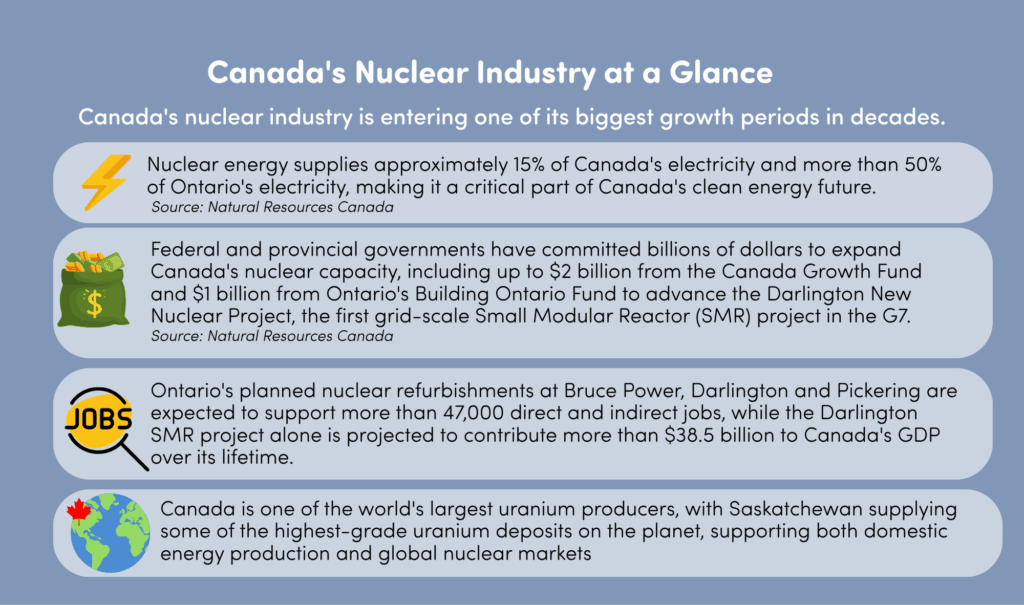
Canada’s nuclear industry is experiencing significant investment, creating opportunities for professionals across dozens of disciplines.
According to Natural Resources Canada, today nuclear energy supplies approximately 15% of Canada’s electricity and more than 50% of Ontario’s electricity, making it a critical part of Canada’s clean energy mix.
Beyond electricity generation, investment continues in uranium mining, fuel processing, medical isotope production, advanced manufacturing and Small Modular Reactor (SMR) development.
“The engineering challenges in nuclear are among the most rewarding you’ll find anywhere. These projects require collaboration across civil, mechanical, electrical, automation and project engineering disciplines, creating opportunities for engineers at every stage of their careers.” Brad Holtkamp, President, Engineering & Technical
For job seekers, this means demand is growing not only for nuclear specialists, but also for experienced professionals who can apply their skills in highly regulated, technically complex environments.
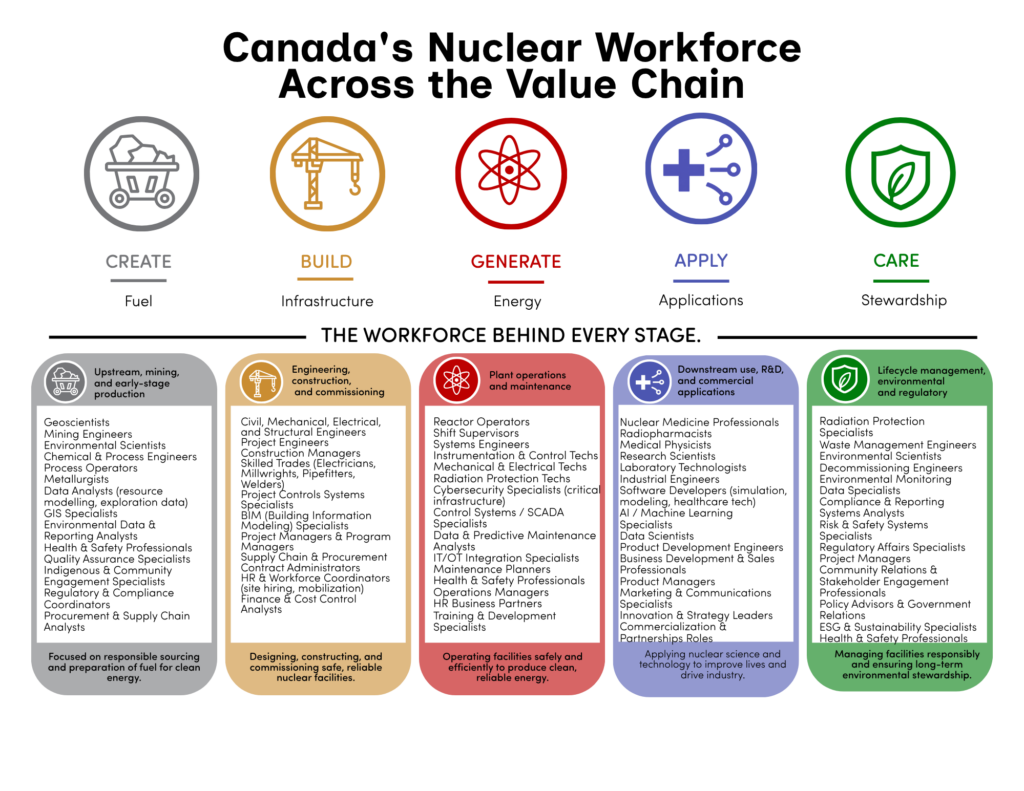
Nuclear Careers Extend Across the Entire Value Chain
One of the biggest misconceptions about the nuclear industry is that careers begin and end inside a generating station.
In reality, Canada’s nuclear workforce spans every stage of the value chain, from uranium exploration and engineering design to construction, operations, medical technologies and environmental stewardship.
Your Skills May Already Transfer Into a Nuclear Career
Many employers aren’t simply looking for candidates with nuclear experience. They’re looking for professionals who understand safety, quality, compliance, project delivery and regulated environments.
If you’ve built your career in construction, manufacturing, mining, aerospace, technology, utilities, government or healthcare, your experience may already align with what nuclear employers need.
Increasingly, digital technologies are becoming just as important as traditional engineering expertise.
“Digital transformation is reshaping every critical industry, including nuclear. Cybersecurity, cloud platforms, AI, automation and data analytics are becoming essential to modern nuclear operations, creating exciting opportunities for technology professionals.” Marco Verna, President Technology & Professional
Nuclear Is More Than Power Generation
While electricity generation remains central to Canada’s nuclear industry, innovation is creating exciting new career paths.
The Canadian Nuclear Association reports Canada is also a global leader in producing medical isotopes that are used around the world to diagnose and treat diseases, supporting millions of medical procedures every year.
This growing intersection between nuclear technology and healthcare is creating demand for professionals in life sciences, quality assurance, regulatory affairs and advanced manufacturing.
“Many people are surprised to learn how closely nuclear and life sciences intersect. From radiopharmaceuticals to medical isotopes and highly regulated manufacturing, the sector offers exciting opportunities for scientists, quality professionals and regulatory specialists.” Scott Murphy President, Life Sciences & Operational Staffing
A Highly Regulated Industry Creates Diverse Opportunities
The nuclear industry is one of Canada’s most highly regulated sectors. Success depends not only on engineers and scientists, but also on professionals who understand governance, procurement, cybersecurity, compliance, documentation and stakeholder management.
“Canada’s nuclear sector operates within one of the world’s most rigorous regulatory environments. That creates opportunities for professionals with experience in compliance, procurement, public programs, security and complex stakeholder management.” Cole Franco Vice-President, Federal Government & Public Sector
These skills are often developed in government, defence, infrastructure and other regulated industries.
Build a Career That Makes a Difference
Unlike many industries that experience significant economic cycles, nuclear projects often span decades, creating long-term opportunities for professionals across multiple disciplines.
Canada also remains one of the world’s largest uranium producers, with Saskatchewan home to some of the highest-grade uranium deposits anywhere in the world stated by the World Nuclear Association.
Whether you’re designing infrastructure, developing software, managing complex projects, supporting healthcare innovation or ensuring regulatory compliance, a career in nuclear offers the opportunity to contribute to projects that have a lasting impact on Canadians and communities across the country.
About Agilus by Synergie
For 50 years, Agilus by Synergie has connected talented professionals with Canada’s leading employers across engineering, technology, life sciences, operations, professional services and government.
As one of Canada’s largest recruitment firms, we understand where industries are growing, what employers are looking for and how transferable skills can open doors to exciting new career opportunities.
Our recruiters live in the communities where they work and are here to help you navigate Canada’s evolving job market with confidence.
Ready to Explore Nuclear Careers in Canada?
The nuclear industry is growing, and employers are looking for talented professionals from a wide range of backgrounds.
Whether you’re an engineer, technologist, skilled tradesperson, project manager, scientist, IT professional or business specialist, Agilus by Synergie can help you discover opportunities that match your experience and career goals.
Frequently Asked Questions
Q1. Do I need nuclear experience to work in Canada’s nuclear industry?
Not necessarily. While some highly specialized positions require nuclear-specific qualifications, many employers recruit professionals from construction, manufacturing, mining, aerospace, technology, healthcare and utilities because of their transferable skills.
Q2. What careers are available in Canada’s nuclear industry?
Career opportunities include engineering, skilled trades, project management, cybersecurity, software development, quality assurance, environmental services, life sciences, procurement, finance, human resources and business operations.
Q3. Where are most nuclear jobs located in Canada?
Ontario is Canada’s largest nuclear market, while Saskatchewan leads uranium mining and fuel production. Opportunities also exist throughout New Brunswick and across Canada’s nuclear supply chain.
Q4. How does nuclear support healthcare?
Canada is a global leader in producing medical isotopes used in cancer diagnosis, treatment and research, creating opportunities for professionals in life sciences, manufacturing, engineering and regulatory affairs.
Q5. Is nuclear a good long-term career?
Yes. Nuclear infrastructure projects often span decades, providing long-term career stability, continuous learning opportunities and exposure to advanced technologies.
Q6. What skills do nuclear employers value most?
Technical expertise, safety-first thinking, quality management, regulatory compliance, project delivery, communication, collaboration and continuous improvement are valued across virtually every discipline.