

Key Takeaways
- Language directly influences application behaviour
- Gender-coded and age-coded wording reduces applicant volume
- 76% of candidates consider diversity when evaluating employers
- Diverse organizations are more likely to outperform financially
- Inclusive job descriptions strengthen employer brand and expand access to talent
Reading time: 7 minutes
Canada’s workforce is evolving quickly. According to Statistics Canada, immigrants represent more than 23% of the population, and labour force participation among workers aged 55+ continues to rise. At the same time, Gen Z is entering the workforce with clear expectations around diversity, equity, and belonging.
If your job postings are not written inclusively, you may be unintentionally narrowing your talent pool before recruitment even begins.
Inclusive recruitment writing is not about political correctness. It is about accessing the broadest possible pool of qualified candidates in a competitive hiring market. For employers facing skills shortages across engineering, technology, life sciences, and operational roles, language matters more than ever.
Why Inclusive Job Descriptions Drive Business Results
The business case for diversity is well established. Recent research from McKinsey & Company shows companies in the top quartile for gender and ethnic diversity are 39% more likely to outperform financially. Diverse teams are also more likely to innovate and adapt to changing markets.
From a candidate perspective, employer brand is equally critical. Glassdoor reports that 76% of job seekers consider workforce diversity when evaluating companies and job offers. More than one-third say they would not apply to an organization where diversity is lacking.
Your job posting is often a candidate’s first interaction with your brand. It signals more than qualifications. It signals your work culture. If language feels exclusionary, qualified candidates may quietly opt out. You will never see the talent you lost.
For more on how perception influences candidate flow, see our blog: 10 Ways to Improve Your Glassdoor Ranking and Why It Matters
The financial impact is also significant. Canadian HR Reporter reports the average cost of employee turnover in Canada has risen to $30,680 per employee, in 2025, increasing pressure on employers already competing for talent. Even small improvements in job posting clarity and inclusivity can help reduce mis-hiring risk and improve retention by attracting better-aligned applicants from the start.
How Language Influences Who Applies
Subtle wording choices significantly impact application behaviour. Research from LinkedIn shows women tend to apply to fewer roles than men and are more likely to apply only when they feel highly qualified. Men apply more readily even when they meet only part of the criteria. Overly rigid job descriptions can therefore reduce applicant diversity before recruitment even begins. Employers should consider who may self-select out when the requirements section is stacked with “nice to haves.”
At the same time, analysis from Textio, which evaluates millions of job postings, indicates that masculine-coded language can reduce female applicant rates by double digits.
Overly rigid qualification lists and coded wording do not just affect perception. They directly influence who enters your recruitment funnel.
Where Bias Shows Up in Job Postings
1. Gender Bias
Long, inflexible qualification lists disproportionately discourage women from applying. Clearly distinguishing between required and preferred qualifications increases application confidence. Avoid gender-coded descriptors such as the below, that may unintentionally skew masculie:
- Dominant
- Aggressive
- Fearless
- Rockstar
- Ninja
Similarly, overemphasizing traits such as nurturing or supportive can skew feminine. Focus instead on measurable skills, outcomes, and competencies. Job titles should also be gender neutral. Replace:
- Actor with Performer
- Fireman with Firefighter
- Chairman with Chair or Chairperson
- Foreman with Supervisor
- Salesman with Sales Representative
These adjustments are simple, but they influence who feels represented in the role.
For a deeper look at gender representation in technical fields, read: Women in Engineering in Canada: The Talent Opportunity Employers Cannot Afford to Miss
2. Racial and Cultural Bias
Bias is rarely explicit. It often appears through assumptions. Avoid phrases like:
- Canadian experience required (unless legally mandated)
- Strong English skills (without defining proficiency levels)
- Clean-shaven (if not operationally necessary)
Instead of assessing cultural fit, evaluate values alignment and behavioural competencies. The term fit can reinforce similarity bias. Alignment focuses on shared standards of performance and accountability. In a country as diverse as Canada, clarity and precision matter.
3. Age Bias
Canada’s workforce is aging. Statistics Canada data shows participation among workers aged 55+ continues to grow. Age-coded phrases such as Age-coded phrases like the ones below may discourage experienced professionals from applying:
- Digital native
- Young and energetic
- High-energy go-getter
If digital capability is required, specify the tools and proficiency expected rather than implying generational preference.
Experience diversity strengthens leadership pipelines and institutional knowledge. As organizations evolve structurally, mid-career professionals often carry the operational expertise that supports AI adoption and digital transformation.
For insight into how workforce structure is shifting, see: The Diamond Model: How AI Is Transforming Workforces and Reshaping Career Pathways
4. Disability Bias
Inclusive job postings also comply with federal and provincial Accessibility Acts. Replace rigid physical requirements with functional descriptions.
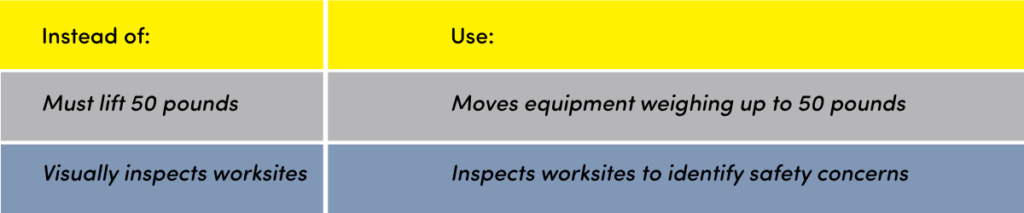
These changes broaden accessibility without lowering standards. Including a statement that accommodations are available upon request further signals inclusion and professionalism and is mandatory in Ontario and Manitoba.
Employer Brand and the Next Generation Workforce
Today’s emerging workforce evaluates organizations the way consumers evaluate brands. Deloitte’s 2024 Gen Z and Millennial survey shows diversity and belonging are core decision factors in where younger professionals choose to work and whether they stay.
In 2026 job postings are brand statements. Organizations that remove bias from recruitment writing signal intentional leadership. Organizations that ignore it risk reputational erosion.
Inclusive recruitment writing also aligns with Canada’s broader legal framework. Section 15 of the Canadian Charter of Rights and Freedoms guarantees equality under the law without discrimination based on race, national or ethnic origin, colour, religion, sex, age, or mental or physical disability. While employment legislation is largely provincial, these national principles shape expectations around fairness, access, and equal opportunity in hiring practices across Canada.
The Strategic Advantage of Inclusive Recruitment Writing
Addressing unconscious bias in job postings:
- Expands your qualified candidate pool
- Strengthens employer brand perception
- Increases access to scarce talent
- Supports innovation and long-term growth
- Aligns with evolving workforce expectations
Sherri Strong, Director Organizational Talent & Development, Agilus Work Solutions, notes:
“Removing bias from job postings is one of the simplest yet most powerful ways employers can broaden their talent pipeline. In a competitive hiring market, inclusive language is a smart and strategic decision.”

About Agilus Work Solutions
Agilus Work Solutions is Canada’s largest privately owned recruitment firm, connecting employers with specialized talent across Engineering, Technology, Life Sciences, Operational Staffing, Professional, and Public Sector roles.
We understand that hiring outcomes are shaped long before interviews begin. Inclusive recruitment writing, structured hiring frameworks, and employer brand positioning all influence who chooses to apply.
If you are looking to broaden your talent pipeline and strengthen your hiring strategy, our team can help audit your job postings, refine your messaging, and connect you with high-performing talent across Canada.
Connect with an Agilus recruitment expert today to build a stronger, more inclusive hiring strategy.
FAQs for Employers
Q1. Does inclusive language actually increase applications?
Yes. Research from LinkedIn and Textio shows wording impacts application behaviour, particularly among women and underrepresented groups.
Q2. Are inclusive job postings about compliance or performance?
Both. They support legal compliance while expanding access to qualified candidates and strengthening employer brand perception.
Q3. Will removing bias lower our standards?
No. It clarifies essential qualifications and removes unnecessary barriers that exclude capable applicants.
Q. 4 How can we audit our job descriptions for bias?
Review for gender-coded language, age-coded phrases, unnecessary credential requirements, and exclusionary physical requirements. Free tools such as Gender Decoder can help identify gender-coded language, but they often address only one dimension of bias. A comprehensive review requires evaluating age-coded language, credential inflation, accessibility, and cultural assumptions. Many organizations partner with recruitment experts to conduct structured audits that align language with inclusive hiring best practices.