

Key Takeaways
- Employment: +18,000 (+0.1%)
- Unemployment rate: 6.5%, down 0.1 percentage points
- Employment rate: 60.8%, up 0.1 percentage points
- Participation rate: 65.0%, unchanged
- Average hourly wages: $37.20, up 3.3% year over year
- Youth employment: +33,000 (+1.2%)
- Core-age employment (25-54): +33,000 (+0.2%)
- Employment age 55+: -47,000 (-1.1%)
Reading time: 7 minutes
June 2026 Labour Market Report
Stats Can’s Labour Force Survey reported a market that was relatively stable in June, adding 18,000 jobs (+0.1%) while the unemployment rate edged down 0.1 percentage points to 6.5%. The employment rate increased slightly to 60.8%, while labour force participation held steady at 65.0%.
On the surface, June was a quiet month. But looking beyond the headline employment number reveals several important shifts for employers. Private-sector employment continued to grow, unemployment declined for the second consecutive month, youth employment improved and wage growth accelerated.
The result is a Canadian labour market that appears to be stabilizing, but remains highly uneven across industries, regions and talent segments.
Looking Beyond the Headline: A Stable Month Doesn’t Mean Nothing Changed
Canada added just 18,000 jobs in June following a much stronger increase of 88,000 in May. Viewed in isolation, that could suggest hiring momentum stalled.
The broader indicators tell a more nuanced story.
The unemployment rate declined to 6.5%, its second consecutive monthly decrease and the lowest rate since January. The proportion of unemployed Canadians who found work between May and June also improved to 24.3%, compared with 21.3% during the same period a year earlier.
At the same time, the layoff rate remained stable at 0.6%, in line with both June 2025 and the pre-pandemic average from 2017 to 2019.
For employers, this is why no single monthly statistic should drive workforce decisions. Employment growth, unemployment, labour force participation, wages and the composition of hiring need to be considered together.
Want to better understand Canada’s monthly employment numbers? Read our guide, How to Read Canada’s Monthly Labour Market Report, to learn which indicators matter and what they can tell employers about the talent market.
Private-Sector Employment Continues to Grow
One of the more interesting signals in June came from the composition of employment.
Public-sector employment declined by 31,000 (-0.7%), while private-sector employment increased by 32,000 (+0.2%), following a gain of 56,000 in May.
The longer-term picture is even more notable.
Canada had 99,000 more people employed in June than a year earlier, with virtually all of that growth concentrated among private-sector employees (+94,000; +0.7%). Full-time employment was also up by 131,000 (+0.8%) year over year.
For employers, the continued shift toward private-sector employment is worth watching. While overall job creation remains modest, businesses continue to add workers even within a cautious economic environment.
Private-Sector Employment Continues to Grow
One of the more interesting signals in June came from the composition of employment.
Public-sector employment declined by 31,000 (-0.7%), while private-sector employment increased by 32,000 (+0.2%), following a gain of 56,000 in May.
The longer-term picture is even more notable.
Canada had 99,000 more people employed in June than a year earlier, with virtually all of that growth concentrated among private-sector employees (+94,000; +0.7%). Full-time employment was also up by 131,000 (+0.8%) year over year.
For employers, the continued shift toward private-sector employment is worth watching. While overall job creation remains modest, businesses continue to add workers even within a cautious economic environment.
Wage Growth Accelerates to 3.3%
Average hourly wages increased 3.3% year over year in June to $37.20, accelerating from 3.0% growth in May.
This is another reason employers should be cautious about interpreting a softer national labour market as an end to talent competition.
Higher unemployment may expand the overall candidate pool, but it does not necessarily increase the supply of workers with specific technical skills, industry experience or professional qualifications.
Compensation pressure can therefore persist even as overall employment growth moderates.
For employers recruiting specialized talent, benchmarking compensation against the specific occupation, industry and region remains more useful than relying on national labour market conditions alone.
Youth Employment Improves, but Challenges Remain
There was encouraging news for younger workers in June.
Employment among Canadians aged 15 to 24 increased by 33,000 (+1.2%), while the youth unemployment rate fell 0.7 percentage points to 12.7%. This followed a 0.9 percentage point decline in May.
Most of June’s increase in youth employment came from part-time work, which rose by 25,000.
The improvement is significant, but context matters. Canada’s youth unemployment rate remains above the pre-pandemic average of 10.8% recorded between 2017 and 2019.
For employers, this represents both a workforce challenge and an opportunity. Organizations able to create meaningful entry points into the workforce through early-career hiring, internships, training and skills development may have access to a talent pool that continues to face more difficult employment conditions than experienced workers.
Hiring Trends Vary Significantly by Industry
June’s industry results reinforce why Canada’s national employment number rarely tells the complete hiring story.
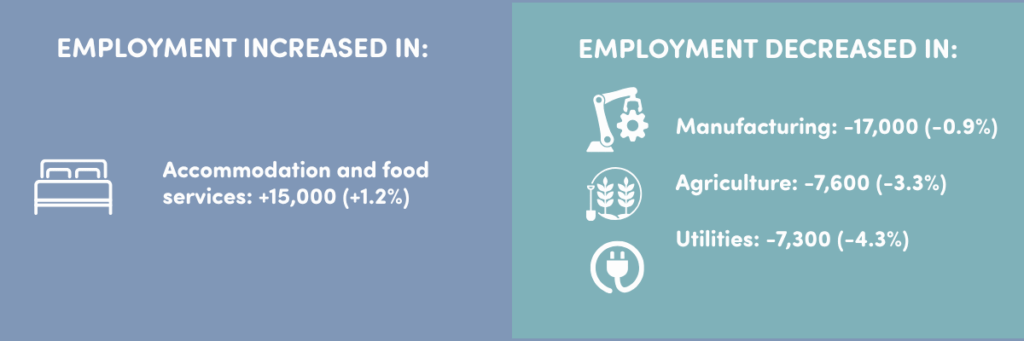
For organizations planning workforce needs, these differences matter.
A relatively flat national employment market can contain both expanding and contracting talent markets. Employers need to consider the conditions affecting their particular industry and occupations rather than assuming that national employment trends apply equally to every hiring decision.
Regional Labour Markets Continue to Tell Different Stories
Employment increased in Nova Scotia (+4,800; +0.9%) and Saskatchewan (+2,900; +0.5%) in June, while employment was little changed in most other provinces.
There were nevertheless several notable regional developments.
Quebec added 14,000 jobs (+0.3%), marking a second consecutive monthly increase after losing a net 91,000 jobs between January and April. The province’s unemployment rate was 5.4%, down from its recent peak of 6.2% in April. Montréal’s unemployment rate fell to 5.9%.
Ontario’s employment level was little changed following a cumulative gain of 84,000 jobs during April and May. The provincial unemployment rate held at 7.0%, but remained 0.8 percentage points below its level a year earlier. Toronto’s unemployment rate was 6.9%, continuing a broader decline from 8.5% in February.
British Columbia’s unemployment rate declined 0.3 percentage points to 6.5%, while Vancouver’s rate held at 6.6%.
Alberta’s unemployment rate increased to 7.0%, illustrating again that provincial labour markets can move differently from the national picture.
For employers recruiting across Canada, geography continues to matter. Candidate availability, compensation expectations and competition for skills can vary considerably between provinces and cities.
What June’s Labour Market Means for Employers
June doesn’t point to either a rapidly strengthening or rapidly deteriorating Canadian labour market.
Instead, it reinforces a pattern of cautious stability with significant differences beneath the national numbers.
Employers should be watching three things in particular:
1. Don’t confuse higher unemployment with easy hiring.
Canada’s unemployment rate has improved in recent months, but availability remains highly dependent on occupation, industry and geography.
2. Private-sector hiring deserves attention.
Private-sector employment increased again in June and accounted for almost all of Canada’s year-over-year employment growth.
3. Wage pressure has not disappeared.
Average hourly wages grew faster in June than in May. Employers competing for specialized skills should continue to benchmark compensation against their actual talent market.
“Canada’s labour market is giving employers more room to be deliberate, but that shouldn’t be mistaken for an abundance of the skills they need. The national numbers may look relatively stable, while the market for an experienced technology professional, engineer or specialized business professional can remain extremely competitive. The organizations making the strongest hiring decisions are looking beyond the headline and understanding the talent market around the specific roles they need to fill.” Marco Verna, President, Technology & Professional, Agilus by Synergie
The Bottom Line
Canada’s June labour market report was not dramatic, and that may be the most important takeaway.
Employment held relatively steady. Unemployment declined. Private-sector employment continued to grow. Wage growth accelerated. Youth employment improved. At the same time, several industries lost jobs and regional conditions remained uneven.
For employers, June reinforces the importance of looking beyond a single headline number.
The question isn’t simply whether Canada’s labour market is getting stronger or weaker. It’s where demand is changing, which skills remain difficult to find and what those conditions mean for your workforce strategy.
Want to see how Canada’s labour market is changing over time? Explore our Monthly Labour Market Snapshots to compare the latest employment, unemployment, wage and hiring trends across Canada.
Frequently Asked Questions
Q1. What was Canada’s unemployment rate in June 2026?
Canada’s unemployment rate was 6.5% in June 2026, down 0.1 percentage points from May. It was the second consecutive monthly decline and matched the unemployment rate last recorded in January 2026.
Q2. How many jobs did Canada add in June 2026?
Employment increased by 18,000 (+0.1%) in June 2026. Statistics Canada characterized employment as little changed following an increase of 88,000 jobs in May.
Q3. Did wages increase in Canada in June 2026?
Yes. Average hourly wages among employees increased 3.3% year over year to $37.20 in June, following year-over-year growth of 3.0% in May.
Which industries gained jobs in June 2026?
Accommodation and food services added 15,000 jobs (+1.2%) in June. Employment declined in manufacturing (-17,000), agriculture (-7,600) and utilities (-7,300).
What does the June 2026 labour market mean for Canadian employers?
June’s data suggests a relatively stable national labour market, but hiring conditions continue to vary significantly by occupation, industry and geography. Employers should consider unemployment, wage growth, industry trends and regional talent availability together when making workforce decisions.
How Agilus by Synergie Helps Employers
Agilus by Synergie helps employers turn labour market insight into practical workforce decisions. With specialized expertise across Engineering & Technical, Technology, Professional, Operational Staffing and Life Sciences, we help organizations understand talent availability, navigate changing hiring conditions and connect with the people they need to move their business forward.
Whether you are planning for future workforce needs, struggling to find specialized skills or responding to changing market conditions, our recruitment experts can help you build a hiring strategy grounded in the realities of your talent market.